
VALEO GROUP
27 November 2026
15 min

- Why Have Materials Become a Strategic Issue for the Automotive Industry?
- How Does Valeo Organize Its Materials Engineering Expertise?
- Decarbonization: How Do Materials Reduce the Carbon Footprint of Valeo Products?
- Circular Economy: How Does Valeo Integrate Recycled Materials Right from Design?
- Rare Earths and Critical Raw Materials: How to Secure Supply in Europe?
- Metals and Composites: How to Lighten and Decarbonize High-Impact Parts?
- Recycled and Bio-Based Plastics: How to Reconcile Sustainability and Technical Requirements?
- Which Parts Does Valeo Already Produce Using Sustainable Materials?
- FAQ: Materials Engineering and Sustainable Mobility

By shifting the environmental impact from the use phase to earlier stages of the life cycle, the rise of electric vehicles is profoundly transforming the selection and carbon footprint of raw materials. In the face of environmental imperatives and the strain on strategic metals caused by batteries, materials science provides essential insight. It makes it possible to reconcile the reduction of the overall carbon footprint, supply sovereignty, and the high technological performance of tomorrow’s mobility solutions.
Christophe Le Ligné
Vice President R&D at Valeo Group
How Does Valeo Organize Its Materials Engineering Expertise?
The knowledge Valeo has acquired about materials over decades, combined with the multidisciplinary profiles of its R&D teams, enables the Group to cover 13 domains of materials expertise, from laboratory testing and analysis to factory production support.
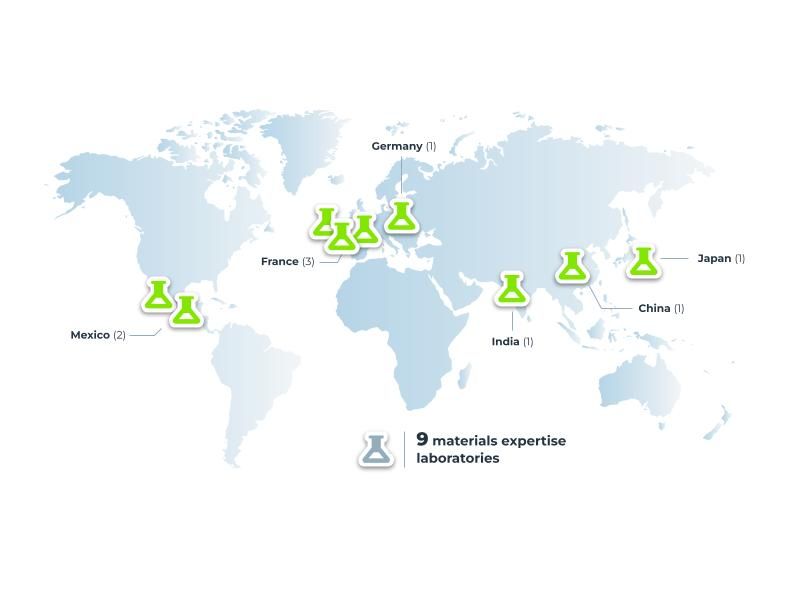
A Global Network of 9 Materials Expertise Laboratories
Valeo relies on a global network of 9 materials research laboratories, bringing together over 60 engineers and technicians. Each region is equipped with a laboratory to enhance responsiveness and foster closer ties with operational teams:
- France: 3 laboratories
- Mexico: 2 laboratories
- Germany, India, Japan, and China: 1 laboratory each
In France, this network revolves around 3 centers of excellence: two in the Paris region (Bobigny and Créteil-Valenton) and one in Auvergne-Rhône-Alpes (Issoire).
What Does the New Materials Laboratory in Valenton Do?
Located within the Valeo Power Technical Center in Valenton, the materials laboratory of the Valeo Power Technical Center is at the heart of R&D dedicated to materials for the entire Group. Covering an area of 300 m², it brings together the competencies and equipment required for all materials expertise domains:
- Spectrometers;
- Thermal and climatic chambers;
- Scanning electron microscope;
- Tensile and fatigue test machines;
- Corrosion test benches.
The laboratory pursues three objectives:
- Support all Group project teams in material selection;
- Guarantee the technical performance and durability of materials, especially recycled ones, to comply with all technical specifications;
- Innovate, remove key technological barriers, and expand investigations into new materials.

Decarbonization: How Do Materials Reduce the Carbon Footprint of Valeo Products?
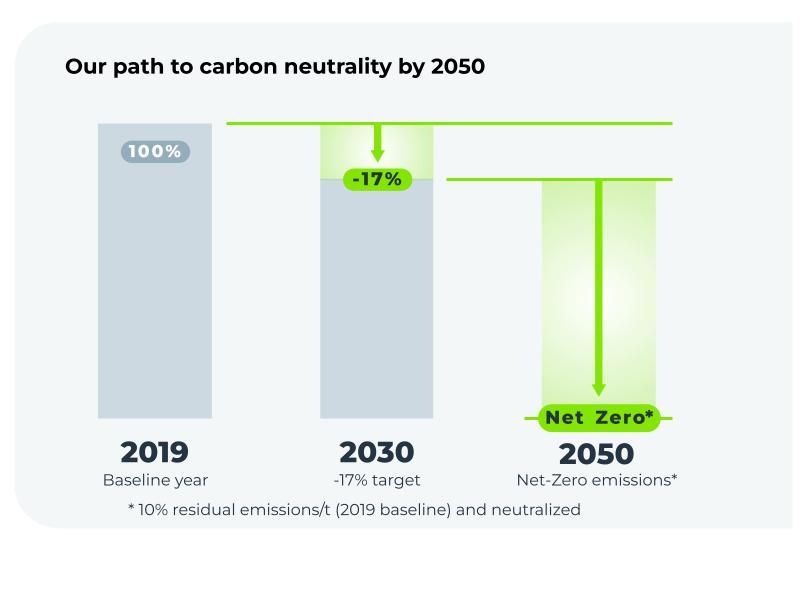
Through its CAP 50 decarbonization plan, Valeo is committed to a carbon neutrality trajectory by 2050, with an intermediate goal of a 17% emission reduction by 2030 compared to 2019.
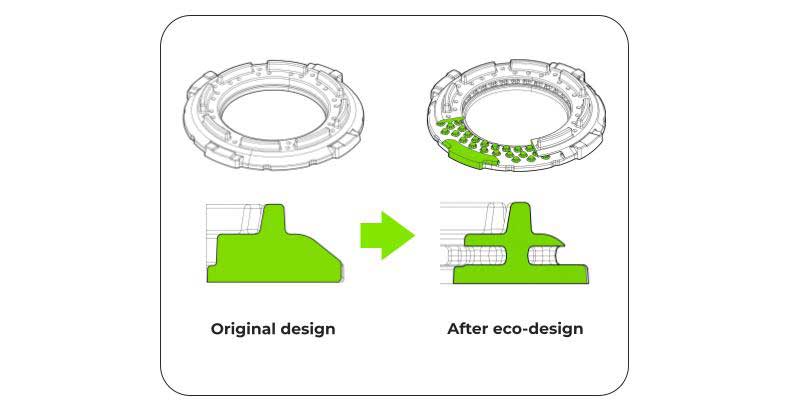
Materials engineering contributes directly to this trajectory. Valeo’s goal is to systematically offer a material alternative—low-carbon, recycled, or bio-based—that reduces the environmental footprint of products with high raw material consumption.
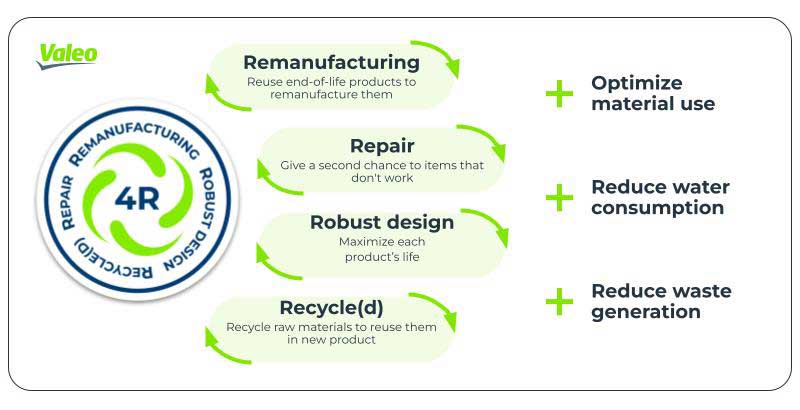
Concretely, Valeo integrates disassembly principles right from design stage to facilitate dismantling, repair, and recycling of end-of-life parts. Backed by 45 years of expertise, Valeo remanufactures over one million parts per year (mechanical, electrical, and electronic). Between 2019 and 2023, the Group also recycled more than 10,000 tons of waste across its sites.
Products increasingly incorporate engineering plastics and electronic circuit boards, which intensifies the challenge of multi-material recycling. Valeo is thus expanding its expertise in material processing with the objective to identify proven recycling processes tailored to its products by 2035.
To guarantee the quality and consistency of recycled plastics, Valeo collaborates with industrial partners. In May 2026, the Group joined the Global Impact Coalition (GIC), bringing together major global chemical and industrial companies to build projects, partnerships, and ecosystems serving chemical carbon neutrality. Valeo contributes its expertise in the automotive value chain to integrate greater circularity into automotive plastics.
What Changes with the European End-of-Life Vehicles (ELV) Regulation?
The July 2026 revision of the European framework on end-of-life vehicles (ELV) marks a turning point for the automotive sector. It mandates close collaboration across the supply chain to meet the following recycled content quotas:
- From 2032: new vehicles must contain at least 15% recycled plastic, originating exclusively from post-consumer recycled (PCR) materials;
- From 2036: this quota will increase to 25%;
- Closed-loop requirement: 20% of this recycled plastic must come from end-of-life vehicles or parts dismantled during the vehicle’s lifespan.
For other materials, such as metals, quotas have not yet been defined.
What Projects Is Valeo Undertaking related to Strategic Metals?
Mindful of challenges surrounding strategic metals like lithium, cobalt, or rare earths, Valeo supports the development of new supply chains and participates in dedicated research and innovation projects:
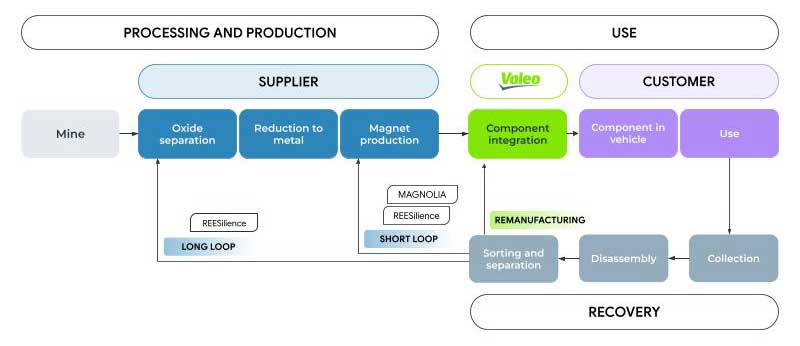
- MAGNOLIA (since 2022): Valeo has improved its processes to facilitate the disassembly of rare-earth permanent magnets;
- REESILIENCE: As part of this program dedicated to magnet recycling, Valeo is helping to establish a European industrial supply chain for the production of permanent magnets;
- EECONE (2023) and ROB4GREEN (2025): These European projects aim to optimize reliability, reduce electronic waste, and extend the lifespan of automotive semiconductors from the design stage onward;
- IAM – Innovative Advanced Materials: Valeo is a member of this initiative bringing together over 350 entities across Europe (academic partners, research centers, industrial players of all sizes and sectors).
Why Develop Rare-Earth-Free Electric Motors?
Traditional electric motors use permanent magnets rich in rare earths, which are at the center of strategic tensions and have a high environmental footprint. To limit these dependencies and improve vehicle environmental performance, Valeo unveiled in 2025 a new generation of electrically excited synchronous motors, without rare earths, developed in partnership with MAHLE:
- Compatible with 400V or 800V high-voltage architectures;
- Up to 340 kW peak power;
- 40% lower carbon footprint compared to a magnet motor.
Discover the electrification solutions from the Power Division.
*Results based on Valeo estimates of carbon footprint. Figures are order-of-magnitude estimates provided for information purposes only.
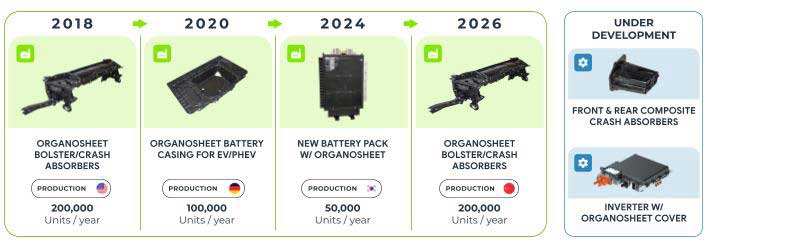
Organosheet: Why Are Composites Replacing Steel and Aluminum?
Proven in laboratories since 2015 and introduced into series production from 2018, organosheet composite parts are progressively replacing steel and aluminum across several product lines linked to vehicle electrification (front-end modules, battery environments) in various regions worldwide.
- Weight savings: up to -30% compared to traditional metal structures;
- Impact: direct vehicle lightweighting and significant carbon footprint reduction across the entire lifecycle.
Recycled Aluminum: An Industrial Reality
Valeo supports automakers in reducing their own carbon footprint with a portfolio of 20 recycled aluminum alloys. These alloys already equip numerous series applications:
- Thermal management: radiators, charge air coolers, and cooling plates for electric vehicle batteries;
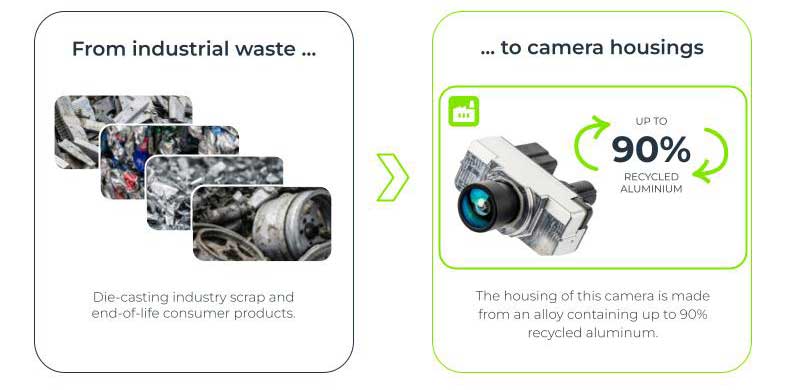
- Electronics and Advanced Driver Assistance Systems (ADAS): onboard camera housings made from an alloy containing up to 90% recycled aluminum, sourced from die-casting scrap and end-of-life consumer products.
Recycled and Bio-Based Plastics: How to Reconcile Sustainability and Technical Requirements?
A modern car carries an average of 100 to 300 kg of plastic, representing 12 to 20% of its total mass, spread across diverse resins: polypropylene (PP), polycarbonate (PC), polyamides (PA), ABS, or PMMA. To decarbonize this family of materials without compromising safety, Valeo activates two complementary levers.
Considering recycled and bio-based plastics, how can sustainability be reconciled with technical requirements?
Bio-Based Polymers
Bio-based solutions range from mature materials, such as polyamides or natural rubber, to next-generation base components—or new “chemical building blocks”—derived from recent innovations in plant or organic science. These molecules are selected to avoid competition with the food supply chain and offer an alternative to petroleum-based resources. Cost currently remains the main barrier to widespread adoption.
Recycled Polymers: What Is the Difference Between PIR and PCR Plastics?
- PIR (Post-Industrial Recycled): these recycled plastics offer high quality but are becoming rarer.
- PCR (Post-Consumer Recycled): more abundant, these plastics are now adapted by Valeo to meet specific product requirements.
The use of recycled polymers requires case-by-case evaluation, due to the diversity of their chemical structures, their origins,the various recycling technologies, and technical constraints of the components they will be used to manufacture.
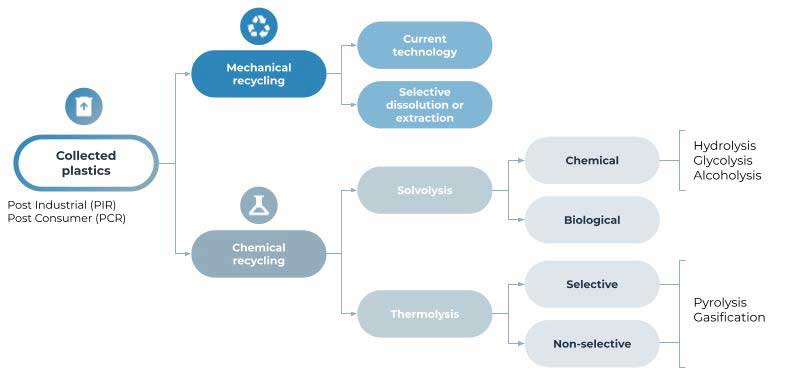
Mechanical Recycling or Chemical Recycling?
- Mechanical recycling is preferred for reducing CO₂ emissions.
- Chemical recycling remains essential for the most demanding applications. It allows handling complex plastics and meeting European ELV standards.
Valeo’s expertise lies in specifying these materials, developing them with partners (academic, technological, or industrial depending on maturity), and aligning them with automotive techno-economic requirements to turn them into industrial reality.
Thermal Management and Electrification
- Bio-based coolant reservoir: injected with castor oil-derived polyamide to substitute fossil polymers, reducing manufacturing CO₂ emissions by 35%.
- Front cooling module: 30% recycled materials across the entire system, including air ducts, front structure, and fan assembly.
- Polypropylene fan shroud: 30% bio-based fibers and 30% PCR recycled content resin, delivering 25% fewer CO₂ emissions compared to fossil material.
Lighting and Visibility: Eco-Design Facing Optical Constraints
Lighting systems from the Light Division integrate a wide variety of high-performance plastic parts. Building on its expertise in materials science and lab infrastructure, Valeo rises to the challenge of complexity.
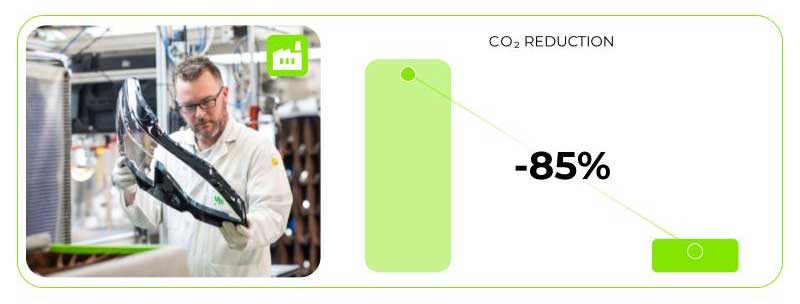
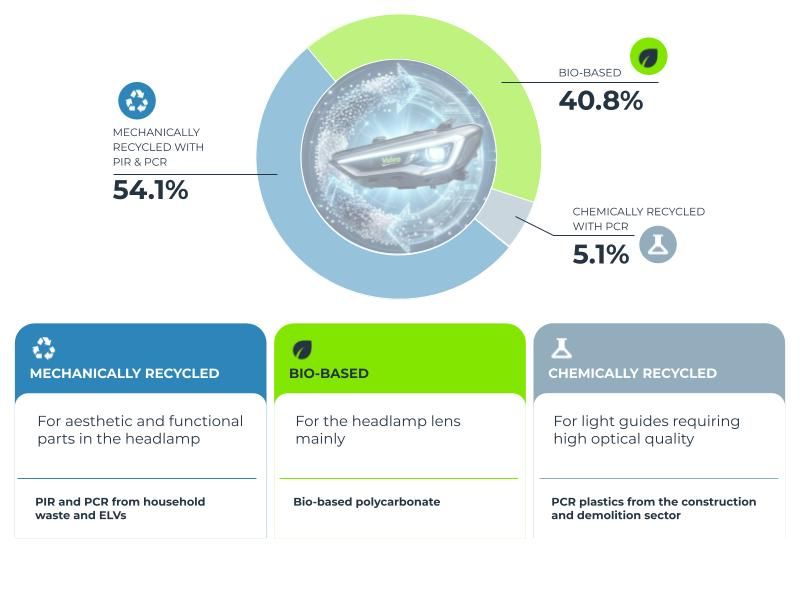
- Bio-based polycarbonate headlamp lens: born from R&D initiatives in 2022, this first optical component made of sustainable material—a brand signature for carmakers—is now mass-produced at Valeo sites in Angers (France) and Chrzanow (Poland). Subject to strict style and transparency constraints, it uses 89% bio-based polycarbonate, achieving an 85% reduction in headlamp lens CO₂ emissions.
- Rear light ((proof of concept): outer lens in PMMA containing 50% recycled plastic and ABS housing with 30% recycled content.
- Multi-material headlamp (use case): 55% bio-based or recycled plastic, including post-consumer (PCR) and end-of-life vehicle plastics.
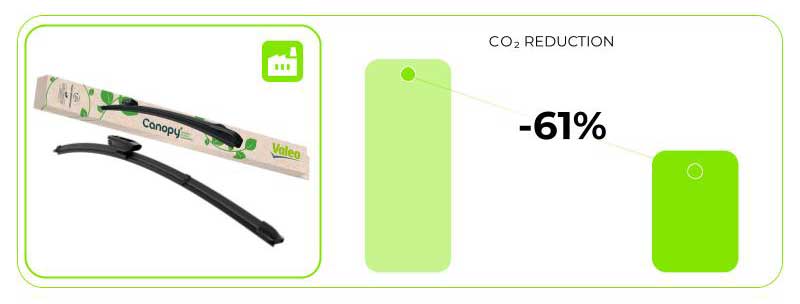
- Valeo Canopy wiper blades: designed from scratch to lower environmental impact, they achieve a 61% carbon footprint reduction compared to a conventional model, a performance verified by the independent organization Bureau Veritas. The rubber blade contains over 80% natural, renewable, or recycled materials (sugar cane, plant oils, carbon black from recycled tires). Metal structures incorporate up to 15% recycled steel, and end clips contain up to 50% recycled plastic.
This approach was recognized on November 19, 2026, in Brussels. The European Association of Automotive Suppliers (CLEPA) named Valeo Top Innovator in the Green Category at its 2026 Innovation Awards for ReVive Polycarbonate, a recycled polycarbonate developed at its Bobigny site.
Driving Assistance and Access Control
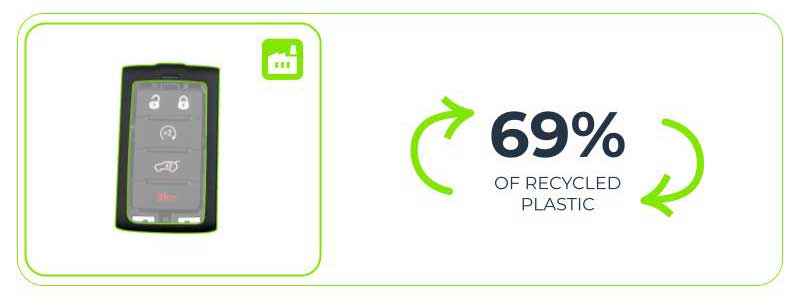
- Key casings: made from plastic containing 69% PIR and PCR plastics (fishing nets, airbags, packaging, textiles), reducing part carbon footprint by 34%.
- ADAS camera housings: an alloy containing up to 90% recycled aluminum, sourced from die-casting manufacturing scrap and end-of-life consumer products.
These accomplishments prove , on an industrial scale, that it is possible to combine product performance and durability with decarbonization and circularity.
To learn more, download the complete press kit: Materials Engineering for Sustainable Mobility.
