
VALEO GROUP
27 July 2026
11 min
Valeo Group
PART 1: Understanding AI in Cars
What Is Artificial Intelligence in Cars?
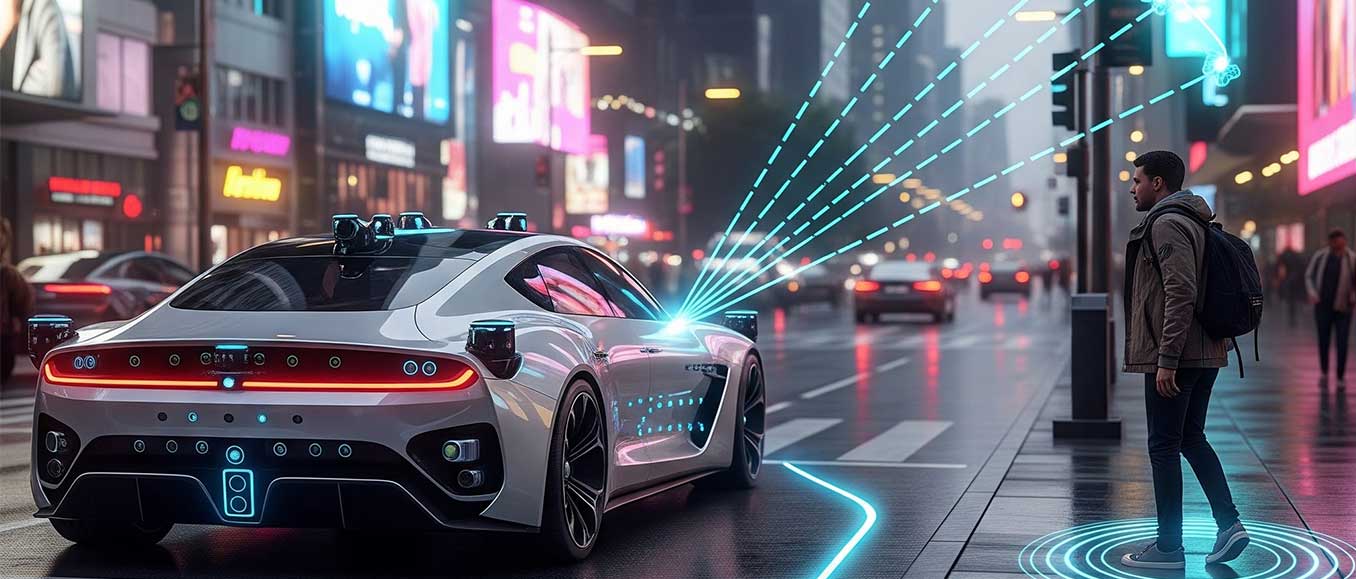
Artificial Intelligence in cars is revolutionizing the way vehicles perceive, interpret and react to their surroundings. By enhancing the performance of perception systems through deep learning and computer vision, AI enables cars to better understand their environment and predict the behavior of other road users, a critical foundation for advanced driving assistance systems (ADAS) and, ultimately, autonomous driving.
AI helps as well to make cars, especially electric cars, more efficient. It allows more personalization of the cabin. All these software solutions can also be updated through the life-cycle of the vehicle thanks to over the air (OTA) updates.
“Artificial Intelligence is a key driver of mobility transformation. For more than 20 years, it has fueled our innovations, particularly in driver assistance systems and automated driving”, explains Chief Technology Officer and Projects Vice-President , of Valeo Brain Division. “Our goal is clear: to make AI not just a tool, but an engine of embedded intelligence that can make mobility safer, more intuitive, and more sustainable.”
How Does AI Work in Vehicles?
Understanding how AI works in vehicles requires looking at four interconnected layers:
- sensors,
- data processing,
- AI models,
- and real-time decision-making
AI runs thanks to a combination of high processing power ECUs, dedicated software and apps, high-performance sensors and actuators, and middleware ensuring seamless intercommunication across apps and ECUs.
Sensors
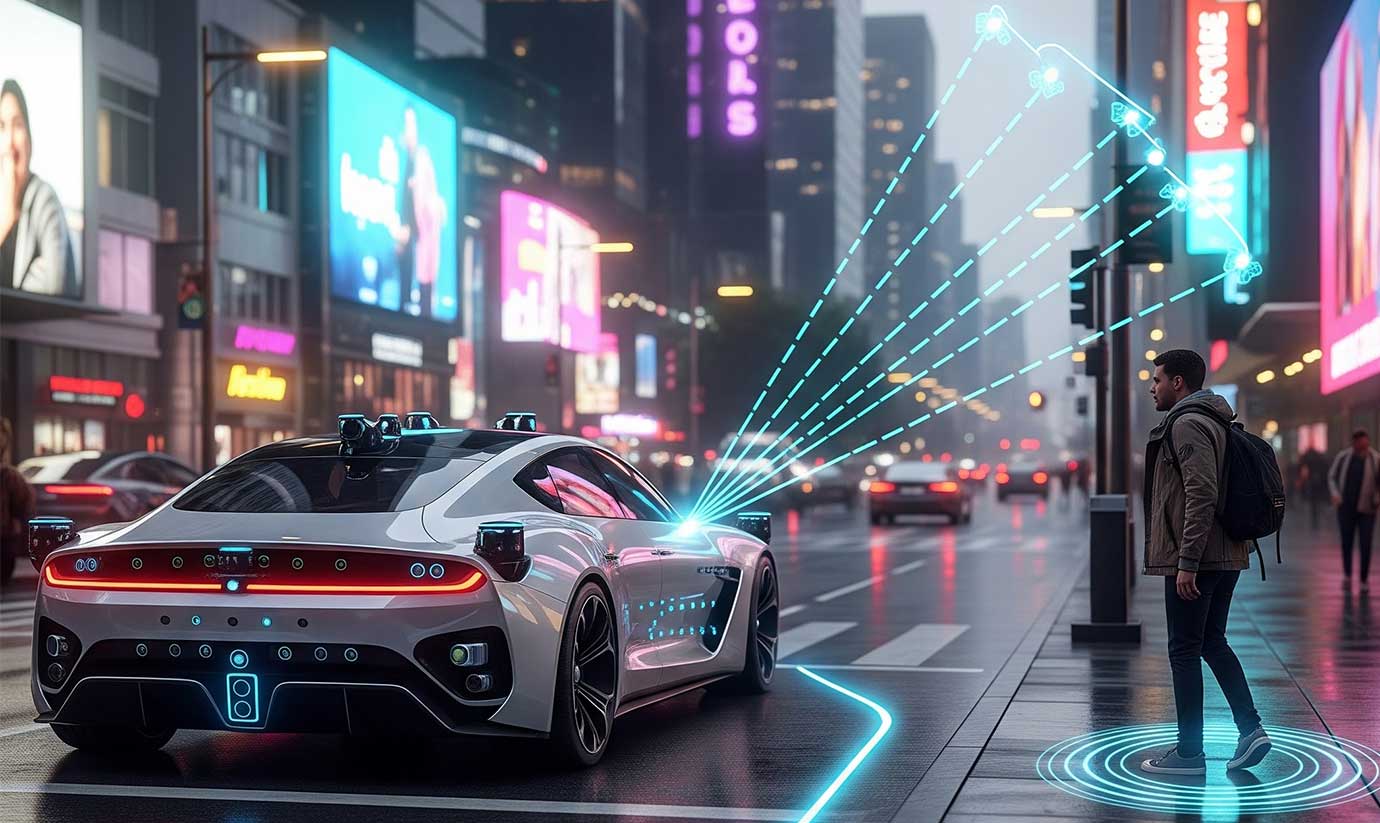
Valeo is the world leader in driving assistance, with a wide array of sensors equipping one in three new cars on the road globally: parking sensors, cameras, thermal cameras, radars, imaging radars and LiDARs (Light Detection And Ranging: a laser radar producing a 3D image of its environment). A sophisticated central computing system analyses and combines the information provided by these sensors, building a 360-degree view of the car’s environment.
Data processing
On average, a modern vehicle contains nearly 200 million lines of code, which is 33 times more than a Boeing 787, making it a true computer on wheels. This means it takes powerful on board controllers based on a System on Chip (SoC), or microprocessor. Like a miniature computer, the SoC provides computing power to perform complex tasks.
According to the needs of the vehicle, the computing power is adapted. For instance, Valeo’s ADAS Domain Control Unit supports multiple System-on-Chip options, from 100 to 250 to 500 TOPS of compute power, to scale the vehicle’s capabilities from surround view and automated parking up to advanced automated driving, transforming raw sensor data inputs into real-time, safety-critical decisions.
AI models
Neural networks are applied to understand the vehicle’s environment. There is no need to code all the rules and all the situations, the machine can learn the rules from the context, using computer vision and deep learning.
It increases the number of complex scenarios studied: starting from a single scene, it becomes possible to create hundreds of variations by incorporating, through generative AI, all sorts of occurrences, such as adding pedestrians, vehicles and cyclists, or changing weather conditions.
Real-time decision-making
AI has enabled to move from a deterministic system, structurally limited, to a probabilistic system. It builds a holistic awareness based on the information gathered by multiple sensors and an implicit world knowledge, helping to make the right decisions in the right timing.
For example, AI helps to predict the behavior of a pedestrian walking on the sidewalk: is he going to cross the road or not? What is he going to do next? Should the car brake or not? AI answers these questions and acts accordingly.
How Is AI Used in Cars Today?
Today, AI is used in cars across three main areas:
- enhancing ADAS performance through better sensor perception,
- improving vehicle efficiency,
- providing greater customization of feature usage.
AI in Advanced Driver Assistance Systems (ADAS)
Valeo was a precursor, already adopting in 2003 in its rear camera a complex parking situation scenes analysis system. AI in cars was developed then to respond to all kinds of driving situations, with new ADAS (Advanced Driver Assistance Systems) features such as automatic emergency braking, automatic parking, adaptive cruise control, lane keeping. All together, they form what is called a level 2 automated driving system, where the driver still has the responsibility for driving, but they are getting a high level of assistance, particularly on motorway driving.
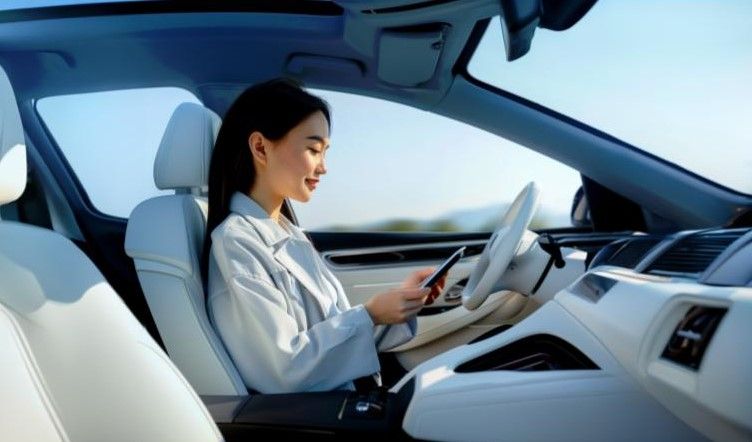
By 2030, around 90% of the cars will be equipped with advanced driving assistance systems, with 50% achieving level 2 or 2+ autonomy, and around 3 millions cars that will reach the next steps of automated driving at level 3 or 4.
AI in Software-Defined Vehicles
The Software-Defined Vehicle (SDV) is the architecture that makes it possible to fully leverage AI, because it centralizes computing power, standardizes data flows, and allows continuous software updates—enabling smarter, safer, and constantly improving vehicle features over time. Unlike traditional architectures, in which each vehicle function has its own controller (distributed architecture), Software-Defined Vehicles (SDV) use a small number of more powerful centralized controllers to manage most functions. This simplifies the car’s electrical and electronic architecture, reduces its weight (fewer cables) and increases its efficiency.

This approach also enables better vehicle connectivity, which is necessary for over the air (OTA) feature updates: a SDV can be regularly updated, upgraded and customized throughout its entire life cycle. It also gives more options to drivers, for example, by selecting certain software functionality and apps, they are able to shape the vehicle based on their changing needs and expectations.
What Are the Benefits of AI in Cars?
The key benefits of AI in cars include:
- safer driving through enhanced ADAS,
- improved energy efficiency for electric vehicles,
- Enable more personalized features
AI is crucial for the evolution of the car of tomorrow, which is increasingly electrified, safer and defined by software. All Valeo ADAS systems include AI enhancement, and an extensive use of AI is an enabler for the automotive industry’s vision of 0 accidents, 0 deaths on the road. As the world leader in ADAS and visibility systems, this is at the core of Valeo’s mission. AI contributes also to autonomous driving targets, improving efficiency and reducing the environmental impact of cars. And AI helps further update the vehicle, accelerating its evolution through its life cycle.
PART 2: AI and Autonomous Driving
AI in Self-Driving Cars
On the way to reaching autonomous driving, AI is an essential pillar, whether for L2++ supervised autonomous driving for personal cars or for self-driving taxi fleets in the US and China, and soon in Europe with Waymo reaching London in 2026.

Is AI Necessary for Autonomous Driving?
Yes, AI is essential for autonomous driving. Without artificial intelligence, vehicles cannot detect, classify, and predict the intentions of other road users in real time, capabilities that are fundamental to safe self-driving technology.
The development of autonomous vehicles requires teaching the car to detect and predict the intentions of other road users, particularly the most vulnerable among them, pedestrians and cyclists. It is also very useful to know their level of attention or distraction caused, for example, by the use of a mobile phone. Also, vehicles will also need to correctly interpret the gestures of law enforcement officers or roadworks personnel. All those functions are enhanced by high-performing AI capabilities.
PART 3: AI Process
How does Valeo Scale Automotive AI? From Valeo.ai Research to AI-Assisted Engineering
Given the critical importance of AI for the development of driver assistance systems and autonomous vehicles, Valeo launched Valeo.ai in Paris in 2017, the world’s first AI research center dedicated to automotive applications, working in close collaboration with the global scientific community. It is conceived as a global competence center for algorithm, infrastructure, learning process, validation and simulation in artificial intelligence for automotive applications. Almost a decade later, AI-assisted engineering is everywhere in the company.
To date, all 9,000 of Valeo’s software and systems engineers are already equipped with and trained in automated coding tools, and 35% of Valeo’s certified code is already generated by AI.
Valeo.ai: research dedicated to automotive AI
Today, the Valeo group boasts some 200 AI experts, and Valeo.ai is at the forefront of research in the automotive industry, especially in the fields of assisted and autonomous driving. Valeo.ai researchers publish in the world’s leading conferences related to AI for perception.
Over the past years, Valeo developed neural networks and deep learning to understand the vehicle’s environment and develop solutions for safer and more automated mobility. Today, the group leverages AI at every stage, from research and development, to product design and in factories with more than 9,000 software and system engineers.
AI to accelerate engineering
Valeo not only uses AI to boost the performance of perception systems, but also uses it to accelerate their development, training and validation. In order to validate driving assistance software, AI is used to compare how the software perceived a scene compared to the real scene, as described or annotated by a human brain. This was done frame by frame, using a huge amount of time and effort from up to 1,000 people working on annotating images from data recording. AI enables automatic annotation of images, saving precious time and money.
Generative AI in software development and in product design
Generative AI has marked a new phase in an increasingly competitive sector, helping Valeo to gain a competitive edge. A partnership with Google Cloud allowed Valeo to equip its staff with generative AI tools, training all 9,000 of its software and systems engineers. By automating coding tasks, they can focus solely on the tasks where they add the most value.
The next step will be automatic component design using generative design. A partnership with Amazon Web Services (AWS) to use cloud-based tools has reduced development times by around 40% for vehicle ECUs. Valeo also has a partnership with Dassault Systèmes that focuses on AI-driven mechanical design, simulation and the establishment of a dedicated laboratory.
A deployment method: AI4All, make AI a competitive advantage at all levels
Valeo’s AI4All program provides impact and value that are very significant, with efficiency gains of several tens of per cent, which is massive. The teams include experts in generative AI and multimodal understanding, computer vision and scene interpretation, machine learning and predictive and uncertainty modeling. As a technology company, Valeo has clearly and naturally prioritized the deployment of AI in R&D.
What Are Digital Twins in Automotive Manufacturing?
A digital twin in automotive manufacturing is a virtual replica of a physical system, such as a sensor, a vehicle, or an entire production line, used to simulate real-world conditions with high accuracy. This technology is transforming how automakers develop, test, and validate ADAS and autonomous driving systems.

The digital twin technology precisely replicates sensor specifications and characteristics embedded in any location around the world or virtual roads, offering an extensive and diverse set of scenarios and environments. This advanced simulation capability provides automakers with a powerful tool to simulate real-world conditions and virtual environments with unprecedented accuracy to develop, test, and validate ADAS and autonomous driving perception systems more efficiently.
Valeo and Applied Intuition have developed a simulation platform that enables AI-powered training, improving object detection, decision-making, and overall reliability. This digital twin platform for advanced driver-assistance systems (ADAS) sensor simulation allows OEMs to bring safe and reliable ADAS features to market faster. It was recognized with a Tech.AD Award.
PART 4: AI in Factories
What is AI in Automotive Manufacturing?
AI can support production processes in many different ways, such as quality control, predictive maintenance, energy savings, etc. 50% of Valeo production sites already use AI.
For example, the Valeo plant and R&D center in Shenzhen (China) is a benchmark, integrating automation, industrial IoT, AI, and other breakthrough technologies of Industry 4.0, continuously enhancing lean manufacturing, driving sustainable development and accelerating intelligent innovation.
How does Industry 4.0 in the Automotive Industry integrate AI?
Industry 4.0 stands for the digitization and automation of manufacturing and as such, AI integration is a natural evolution. AI allows faster and more efficient manufacturing, while reducing defects on production lines through advanced quality controls. AI can also guide predictive maintenance for an ultimate optimization of the facilities.
How AI Is Transforming Automotive Production
AI allows improvements in automotive production on many levels. It starts with virtual manufacturing engineering, allows a lot of flexibility in the industrial process, and scalability to be able to react faster to changing demand.
The collaboration between Valeo and Google Cloud includes deploying gen AI (generative AI) tools to support higher productivity in product design, engineering, software testing and integration.
As part of the partnership, Valeo will be providing key feedback that Google will use to evolve and refine these solutions.
Predictive maintenance in car manufacturing
The processing power and generative models of AI applied to the industry give also the possibility to have an optimized predictive maintenance of the facilities and tools, avoid production stops and improve maintainability. An estimated 20% of breakdowns could be avoided thanks to the contribution of AI.
AI for automotive quality control
AI used on quality control on the production lines allows analyzing defects in real time, with much more speed and accuracy than human-made controls. It contributes to higher quality standards and quicker reactions in case of production issues. Powered by AI, based on deep learning, our quality control is significantly improved, with up to 10 times less classification mistakes than with human control.
AI-driven production optimization
Another example of the use of AI in the industrial sector concerns the optimization of energy consumption. Of course, AI can be used to optimize consumption at a central level, but this requires the entire factory to be fitted with sensors, which represents a significant cost for existing factories.
An alternative is to measure energy consumption at the production line level and thus seek to optimize it. To do this, a mobile device, a “suitcase”, has been developed at Valeo’s Abbeville plant (France). The kit consists of connected, wireless energy sensors, a data collector and a laptop running AI specifically trained by Valeo. Initial tests have yielded energy savings of up to 20%, and the device is currently being rolled out across the group’s other sites.
Smart factories and “Lights-Out” production: the future of automotive manufacturing
In total, the Valeo Shenzhen site (China) has implemented 42 projects to create a transparent, efficient and AI-enabled intelligent factory. These projects include AI solutions and 14 advanced algorithms, such as Generative AI troubleshooting.
It also features a fully automated “lights off” workshop, where production lines operate autonomously in a space where, as the name suggests, there are no lights, because no operators are required. The lights only come on when a technician needs to intervene to resolve any anomaly that might arise.
The application of these innovative projects has dramatically reduced the defective rate of smart front cameras, shortened lead time by 34.5%, increased productivity by 60.2%, and reduced unit energy consumption by 27.1%, enabling overall superior production with high quality, high efficiency, and lower cost. The site has also been able to reduce its CO2 emissions by 41% in five years.
PART 5: Wrap-up
The Benefits of Automotive Artificial Intelligence
The automotive industry is undergoing the greatest technological transformation in its history, with the constantly growing proportion of electric cars and software-defined vehicles, leading to safer vehicles and greater driving autonomy.
Valeo has become an “AI-driven company” in technologies, in development processes (design optimization, simulation, time reduction), in factories (quality control, predictive maintenance, energy savings), and for all employees.
AI is a game changer for R&D, and new partnerships are supporting this evolution. As part of a partnership with Google Cloud, 100% of Valeo’s software engineers are already trained and equipped for AI-assisted coding. More than 25% of Valeo’s certified code is now generated by AI.
The collaboration with Amazon Web Services (AWS) allows to reduce ECU development times by more than 40% thanks to virtualized hardware labs. Partners also include Dassault Systèmes for generative designs of mechanical parts and Zuken for generative design of Printed Circuit Boards (PCBs).
Finally, through the AI4all program, Valeo deployed 84 AI agents to boost R&D efficiency. Valeo’s ambition is clear: to be among the leaders in AI applied to the automotive industry, making the most of it for greener, safer and smarter mobility.
The Future of AI in Cars
AI will be enabling progressively more sophisticated and higher-performing solutions for greater automated driving, safety, electric driving efficiency and more personalized HMI. AI is not just a tool, but an engine of embedded intelligence that can make mobility safer, more intuitive, and more sustainable, providing the best service to the driver and the passengers. A promise of progress in every aspect of the in-car experience.
